North Wales is home to some of the most magnificent castles in Britain. Here are ten you absolutely shouldn't miss.
North Wales boasts an extraordinary collection of medieval castles, many built by Edward I during his conquest of Wales in the 13th century.
1. Caernarfon Castle
Perhaps the most famous of all, Caernarfon Castle is a UNESCO World Heritage Site. Its imposing polygonal towers and banded stone walls were designed to echo the walls of Constantinople.
History
Construction began in 1283 under Edward I as part of his 'iron ring' of fortresses to subdue North Wales. Built on the site of an earlier Norman motte-and-bailey castle and a Roman fort (Segontium), Caernarfon was designed to be the most visually impressive of all Edward's castles. Its banded stone and polygonal towers were inspired by the walls of Constantinople, reinforcing Edward's imperial ambitions. The first Prince of Wales — Edward's son, later Edward II — was born here in 1284, establishing a tradition that continues to this day: Prince Charles was invested as Prince of Wales at Caernarfon in 1969.
What to See
The Eagle Tower, the Queen's Tower, and the Royal Welsh Fusiliers Museum are highlights. You can walk the walls and towers for panoramic views of the Menai Strait and Snowdonia.
Practical Information
- Nearest postcode: LL55 2AY
- Managed by: Cadw (admission charge)
- Parking: Several town-centre car parks within walking distance.
- Opening: Daily; check Cadw website for seasonal hours.
Things to Do Nearby
Walk the Segontium Roman Fort ruins, explore the walled town, or take a boat trip along the Menai Strait. The Welsh Highland Railway also departs from Caernarfon.
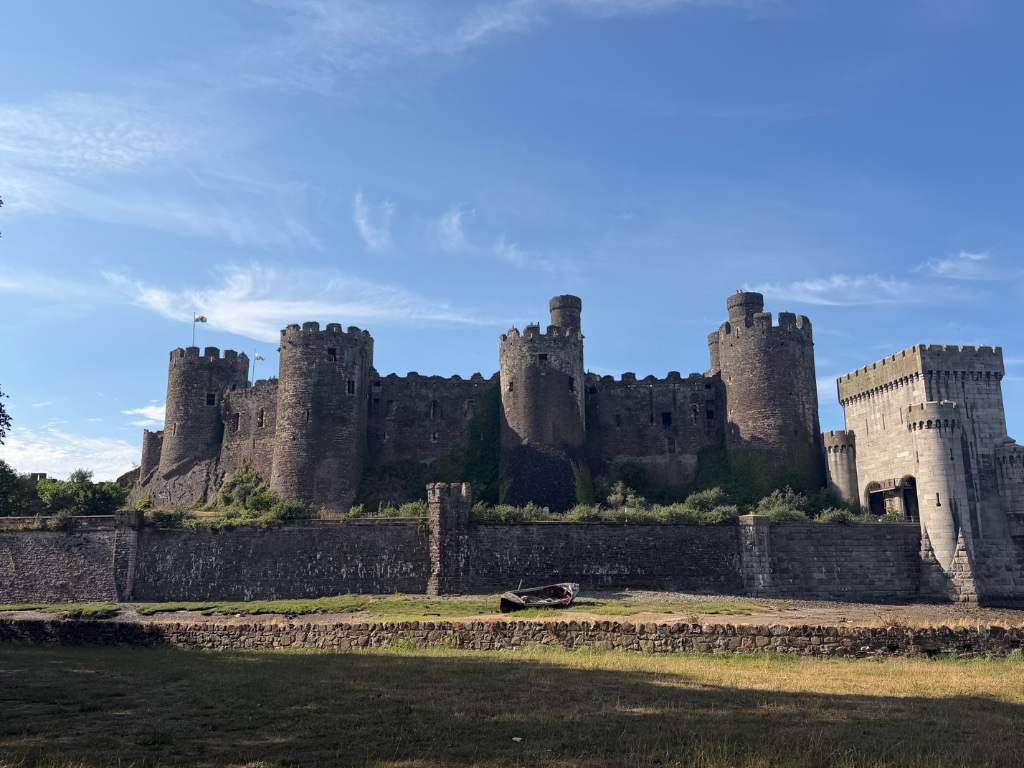
2. Conwy Castle
Another UNESCO-listed fortress, Conwy Castle features eight massive towers and a nearly complete town wall circuit. The views from the battlements are spectacular.
History
Built between 1283 and 1289 by Edward I, Conwy Castle was part of the same campaign as Caernarfon. It replaced the Welsh monastery of Aberconwy, which was relocated to Maenan. The castle played a role in several conflicts — it was held by Richard II in 1399 before he was deposed, and it was a Royalist stronghold during the English Civil War. Remarkably, the town walls, stretching nearly a mile with 22 towers, remain almost intact.
What to See
The castle's eight towers can be climbed for far-reaching views. Don't miss the suspension bridge — one of Thomas Telford's masterpieces — at the entrance. The town walls encircle the medieval centre.
Practical Information
- Nearest postcode: LL32 8AY
- Managed by: Cadw (admission charge)
- Parking: Several car parks around the town walls.
- Opening: Daily; check Cadw website for seasonal hours.
Things to Do Nearby
Explore Conwy's quayside, visit the smallest house in Great Britain, cross Telford's suspension bridge, or visit Plas Mawr — a beautifully preserved Elizabethan town house run by Cadw.
3. Harlech Castle
Perched dramatically on a rocky crag, Harlech Castle overlooks the sea and the mountains of Snowdonia. Its 'way from the sea' — a fortified stairway — is a marvel of medieval engineering.
History
Built by Edward I between 1282 and 1289, Harlech Castle occupies a naturally defensible position atop a rocky outcrop. During the Welsh uprising of 1294, it withstood a siege. Most famously, it was the last Lancastrian stronghold during the Wars of the Roses — its seven-year siege inspired the stirring song 'Men of Harlech'. The castle's 'way from the sea' — a gated fortified stairway descending nearly 200 steps to the shoreline — allowed it to be resupplied by ship, a vital feature in times of siege.
What to See
Climb the towers for breathtaking views over Cardigan Bay and the Rhinogydd mountains. The gatehouse is one of the most impressive of all Edward's castles.
Practical Information
- Nearest postcode: LL46 2YH
- Managed by: Cadw (admission charge)
- Parking: A car park sits at the foot of the castle.
- Opening: Daily; check Cadw website for seasonal hours.
Things to Do Nearby
Walk along Harlech's wide sandy beach, play the famous Royal St David's Golf Club links course, or explore the village with its shops and cafes.
4. Beaumaris Castle
The last and largest of Edward I's castles, Beaumaris was never fully completed but is considered the most technically perfect concentric castle in Britain.
History
Construction began in 1295 by Edward I's master builder James of St George, on the marshy shore of the Menai Strait. It was the last and largest of Edward's Welsh castles, designed as a perfect 'walls within walls' concentric fortress. Work stopped in 1298 as funds were diverted to Scotland, and the castle was never completed — the inner towers lack their upper floors. Despite this, it is considered the most technically perfect concentric castle in Britain. It was briefly held by Owain Glyndwr's forces during the early 15th century.
What to See
Explore the moat, gatehouses, and inner ward. Information panels explain how the castle would have looked had it been finished. The water-filled moat remains one of the best examples of medieval castle water defences.
Practical Information
- Nearest postcode: LL58 8AP
- Managed by: Cadw (admission charge)
- Parking: Street parking nearby.
- Opening: Daily; check Cadw website for seasonal hours.
Things to Do Nearby
The town of Beaumaris offers a charming promenade, the Victorian Beaumaris Gaol, and boat trips to Puffin Island. Cross the Menai Bridge to Anglesey's beaches.
5. Dolbadarn Castle
Built by the Welsh prince Llywelyn the Great in the early 13th century, Dolbadarn Castle stands on a rocky hillock at the foot of Snowdon, just outside the village of Llanberis. Its sturdy round tower is remarkably well preserved and offers stunning views over Llyn Padarn and the surrounding mountains.
History
Dolbadarn was a native Welsh castle, built by Llywelyn ap Iorwerth (Llywelyn the Great) sometime around 1220, possibly on the site of an earlier fortification. It controlled a strategic mountain pass between Snowdonia's interior and the north coast — a route vital for trade and troop movement. The round tower, which still stands to its full height today, is considered one of the finest surviving examples of native Welsh military architecture. After Llywelyn's death, the castle was used by his grandson, Llywelyn ap Gruffudd, who according to tradition was held prisoner here by his brother Owain ap Gruffudd. Following the English conquest in 1283, the castle lost much of its military significance as Edward I built his own great fortresses at Caernarfon and elsewhere. By the 18th century, Dolbadarn had become a romantic ruin — the artist J.M.W. Turner painted it several times in the late 18th century, helping to popularise it as a picturesque destination.
What to See
The centrepiece is the 40-foot round tower, which you can still climb via an internal spiral staircase to reach the upper floors. The remains of a hall and curtain wall surround it. Information panels on site tell the story of the castle and its place in Welsh history.
Practical Information
- Nearest postcode: LL55 4UG
- Managed by: Cadw (free entry)
- Parking: A small layby is available nearby; the main car parks in Llanberis are a short walk away.
- Opening: Open year-round during daylight hours — it's an unstaffed site with no admission charge.
- Best for: Those who want to experience authentic Welsh castle history away from the crowds at the larger Edwardian castles.
Things to Do Nearby
Llanberis is one of Snowdonia's most popular hubs. From here you can catch the Snowdon Mountain Railway, explore the National Slate Museum, walk the shores of Llyn Padarn, or take on the challenge of climbing Snowdon itself — either on foot via the Llanberis Path or by the railway.
6. Dolwyddelan Castle
Built by the Welsh prince Llywelyn the Great, this mountaintop castle commands stunning views of the surrounding countryside.
History
Built by Llywelyn the Great in the early 13th century, Dolwyddelan Castle was a native Welsh fortress guarding a strategic mountain pass. It's believed Llywelyn may have been born nearby at Tomen Castell, an earlier motte-and-bailey. The castle dominated the route between the mountain heartlands and the coast, allowing Llywelyn to control movement through Snowdonia. After Edward I's conquest in 1283, the English garrisoned it and added a second rectangular tower. By the Tudor period, it had fallen into disrepair.
What to See
The castle sits dramatically on a ridge with sweeping views of the Moel Siabod and Snowdon ranges. The western tower can be climbed for the best panoramas. The eastern tower is a later English addition.
Practical Information
- Nearest postcode: LL25 0JD
- Managed by: Cadw (admission charge)
- Parking: A small car park sits a short walk below the castle.
- Opening: Daily; check Cadw website for seasonal hours.
Things to Do Nearby
Walk the nearby Moel Siabod mountain, explore the village of Betws-y-Coed (15 minutes away), or follow the scenic A470 through the Lledr Valley.
7. Criccieth Castle
A castle with a mixed Welsh and English history, Criccieth sits on a headland overlooking Tremadog Bay.
History
Criccieth is unique among North Wales castles for being built by the Welsh and later held by the English. Built by Llywelyn the Great in the 1230s, it controlled trade along the southern coast of the Lleyn Peninsula. After Edward I's conquest, it was captured and reinforced. During Owain Glyndwr's uprising in the early 1400s, it was besieged and its south-east tower was undermined and collapsed — the castle never recovered and was left as a ruin.
What to See
The gatehouse and twin towers are Welsh-built; the later English additions are clearly visible. The views over Tremadog Bay to Harlech are magnificent. Look for the remnants of the siege damage on the south-east tower.
Practical Information
- Nearest postcode: LL52 0DP
- Managed by: Cadw (admission charge)
- Parking: A car park sits at the foot of the castle.
- Opening: Daily; check Cadw website for seasonal hours.
Things to Do Nearby
Explore Criccieth's sandy beach and promenade, visit the Cadwaladr's Ice Cream parlour, or take the short drive to the Italianate village of Portmeirion.
8. Rhuddlan Castle
A striking concentric castle with a unique diamond-shaped inner ward.
History
Rhuddlan Castle was built by Edward I from 1277 following the First Welsh War, making it the earliest of his great Welsh fortresses. Its design pioneered the 'concentric' layout — walls within walls — that Edward would perfect at Beaumaris. A remarkable engineering feat accompanied the castle: Edward had the River Clwyd diverted for nearly two miles to provide a deep-water channel for resupply by ship. The castle's diamond-shaped inner ward is unique. After the conquest, Rhuddlan became an administrative centre, and it was here that the Statute of Rhuddlan (1284) was issued, formally annexing Wales to England.
What to See
Explore the diamond-shaped inner ward, the twin-towered gatehouse, and the remains of the river channel. The layout of the concentric defences is unusually clear.
Practical Information
- Nearest postcode: LL18 2AD
- Managed by: Cadw (admission charge)
- Parking: A small car park sits adjacent to the castle.
- Opening: Daily; check Cadw website for seasonal hours.
Things to Do Nearby
Walk along the River Clwyd into Rhyl, visit the nearby Twthill mound (an earlier motte), or explore the Victorian seaside town of Rhyl.
9. Penrhyn Castle
A magnificent 19th-century neo-Norman castle near Bangor, Penrhyn is one of the National Trust's grandest properties in Wales.
History
Penrhyn Castle was built between 1822 and 1837 for George Hay Dawkins-Pennant, a wealthy slate quarry owner. Designed by Thomas Hopper in the neo-Norman style, it was built on the site of a medieval castle and later Georgian house. The Pennant family's fortune came from the vast Penrhyn Quarry — at one time the largest slate quarry in the world — and the castle's opulence reflects that immense wealth. The castle also has a darker history: the Penrhyn Quarry strikes of 1900–1903 were among the bitterest labour disputes in British industrial history. The castle and its estate were given to the National Trust in 1951.
What to See
The interiors are extraordinarily lavish — the grand hall features a Norman-style vaulted ceiling, and the one-ton slate bed made for Queen Victoria is a highlight. The castle houses one of the finest art collections in Wales, including works by Canaletto and Rembrandt. The gardens, including a Victorian walled garden and extensive grounds, are beautiful year-round. The railway museum on site displays narrow-gauge quarry locomotives.
Practical Information
- Nearest postcode: LL57 4HT
- Managed by: National Trust (admission charge; free for members)
- Parking: Free on-site parking.
- Opening: Check National Trust website — seasonal opening days and hours vary.
Things to Do Nearby
Walk the Menai Strait, cross to Anglesey via the Menai Suspension Bridge, or explore the nearby city of Bangor with its cathedral and Victorian pier.
10. Denbigh Castle
With its striking triple-towered gatehouse, Denbigh Castle is one of the most atmospheric ruins in Wales.
History
Denbigh Castle was built by Edward I on the site of a Welsh fortress captured from Dafydd ap Gruffudd in 1282. Its construction was supervised by James of St George, Edward's master builder. The castle's most distinctive feature is its great triple-towered gatehouse, one of the most impressive in Britain. However, the castle was never fully completed — and it suffered during Owain Glyndwr's rebellion, when it was attacked and damaged. In later centuries it was deliberately slighted during the Civil War, leaving the dramatic ruin we see today.
What to See
The triple-towered gatehouse is the highlight — you can climb into the towers. Extensive ruins of the curtain wall and towers encircle the town. The views from the walls extend over the Vale of Clwyd to the coast.
Practical Information
- Nearest postcode: LL16 3BB
- Managed by: Cadw (admission charge)
- Parking: Street parking nearby.
- Opening: Daily; check Cadw website for seasonal hours.
Things to Do Nearby
Walk the medieval town walls of Denbigh, explore the remains of the priory, or visit the market towns of Ruthin and St Asaph nearby.
Planning Your Castle Tour
Many of these castles are managed by Cadw and offer great value multi-site tickets. Why not base yourself in a holiday cottage and explore several during your stay?
Locations Map
Disclaimer: Prices, opening times, and postcodes shown on this page are sourced from third-party sources and may change without notice. Please check with individual locations before planning your trip. stayinnorthwales.co.uk accepts no responsibility for any incorrect information.